
http://www.youtube.com/watch?v=hkIC629sos0

“To rage and mock is gentlemanly, to grumble and whine is not” Giuseppe Tomasi di Lampedusa


"It would have looked big budget if they'd spent £20,000."
Jings, I thought, 'a sixty second advert of wondrous quality, with an excellent song, jam packed with Scoddish slebs for £2,000, what colour is the sky in this "insiders" world?
Now having been involved in the 'glamorous' world of telly production for a wheen of years, I pondered, at the costs, thankfully the article explained that the rights to the song cost £15,000. For a whole year, pretty darn good. I once enquired about using a 30 second burst of Charles Trenet's 'La Mer' a TV project and was quoted a price of £7,000 for 10 seconds...and that was nearly 20 years ago...However, I digress...I then happened upon BBC Scotland, lapping up this mince like a cake hungry chum slut. Using the rather ambiguous headline,
SNP ad 'cost more than Slumdog'
'Mmm', thought I, an 'SNP ad'. What like a Party Political broadcast? Then like Douglas Fraser's last expenses claim to The Herald, the actual cost rose to a ginormous £559,287
http://news.bbc.co.uk/1/hi/scotland/7999044.stm
Ah but that includes the marketing, promotion and rather importantly the transmission costs in various foreign markets. They then inform us that Mr McDonald was actually wrong that Slumdog in reality cost £10 million pounds rather than the £3million he bandied about like free toilet paper.
This is where my previous experience in production costs come in handy. Low budget films that you have seen in the cinema did not cost the pennies the producers tell you they did, that is part of the marketing mince they want you to buy into.
Reservoir Dogs, Desperado, Do the Right Thing, all done on deferred payments and credit cards. B-O-L-L-O-C-K-S. Each one of these films and Slumdog were party to massive investments in marketing. Slumdog Millionaire was distributed in the US by Fox Searchlight, when they put out a film on US general release in 1000's of screens they spend an average of $30 million dollars on promotion and marketingper fillum...and then when it got the Oscar nod, well double that figure. Every dollar spent getting the Oscar, accrues another 10 dollars on DVD sales and merchandising...
Grrr so for Labour to compare the costs for an advert that is designed to encourage tourists to visit and spend money in Scotland (that includes the parts that are still Labour afflicted) you can surmise that my blood is fairly well close to boiling.
Labour you expect this mince from, but for BBC Scotland to claim Homecoming is an 'SNP ad' and then double the price is just downright insidious. Whichever Labour lackey decided this is the path to impartial reporting needs taken out and given a right good shoeing.


Everton fan Holleran, with his lip all a quiver, replied: "They’re not coping. I carried out a surgery the other week, and had people from 9am to 6.15pm, complaining about new contracts, new working conditions, the pressure they have been put under.
"I was getting reports of senior people in tears at The Herald. What epitomises the loss of morale is when I met with the managing director of Newsquest after their announcement, he said we want between 30 and 40 journalists to go.
"They had 51 volunteers. That tells you the level of morale."
Yep, the recession is hitting Scottish journos hard. The clichéd view of the hard drinking, hard man Scottish journalist is impacting on this generation who are oft seen crying into their expenses fuelled Mojitos whilst twittering on their Blackberries about how evil their bosses are to them..."In the past five years there have been a number of actions that have impacted on the quality of the newspapers in Scotland," he said.
"I'm talking of a number of appointments where editors originated from south of the Watford Gap, shall we say.
"They were appointed editors of Scottish newspapers without knowing the local patch. That was a big starting point.
"They're trying to regain that momentum. However, during that period, as profitability of these titles has gone up – and it has gone up, quite dramatically - they have closed a number of correspondents.
"There's a lack of coverage of European Parliament, in Brussels and Strasbourg, the number of columnists has gone down, there's less diversity. That's part of the problem of falling circulation."
Chunky bearded Scouser Paul Holleran, 58, father of three, with a twinkle in his eye, also cited competition from English papers with Scottish pages, especially the "cut-price" Daily Star and Sun.
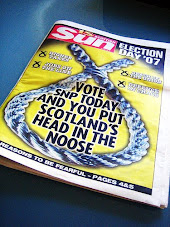
Sooooooooo appointing English editors with a 'British' perspective to Scottish titles has not worked. The endless torrent of anti-SNP headlines and stories in the Hootsman, Herald, Daily Labour and faux Jock blatts has merely brought about a paradigm shift in the Scottish electorate and has seen the "Nationalists Seize Control" of holyrood and Local Authorities the length and breadth of Alba.


After centuries of fighting the English to maintain independence, the two thrones were united when James VI of Scotland became James I of England in 1603, after Elizabeth died childless. In 1707, the two countries were joined under one parliament - the one in London. For the next 300 years, Scotland helped build the British empire, contributed more soldiers per capita to Britain's wars than any other region, invented more things, and had more than its share of prime ministers. Edinburgh became the seat of the Scottish enlightenment, a remarkable burst of creative energy in the late 18th and early 19th centuries. But something of William Wallace, Robert the Bruce, and the independence of yore lingered in the Scottish heart.
Ten years ago, Scotland got its own parliament back, with limited powers. Defense and diplomacy are in London's hands. The Scottish National Party won the election of 2007 by a whisker. Some thought the Scottish Nationalists' minority government would fail, but it hasn't. Neither has Salmond, whose rapier repartee is often on display in the parliamentary put-down that Britons love.
On a recent visit to Edinburgh, I met the first minister in his office in the new Scottish parliament, a startling architectural statement in the tumble-down modern style. An economist by training, Salmond is a big admirer of the late John Kenneth Galbraith and began quoting some of his work from memory.
His plan is to get a referendum on Scottish independence before the people sometime next year. Polls don't show a majority of Scots ready for independence yet, but Salmond believes that they do want the choice. Getting a bill passed on a referendum will be difficult because neither Labor, nor the Tories, nor the Liberal Democrats want any such thing. During my visit, the Scottish edition of the Times of London revealed that in the 1970s the British Labor government went so far as to redraw the boundaries of North Sea oil to deprive Scotland of much of it, and even contemplated stirring up separatists movements in the Scottish isles of Orkney and the Shetlands, should Scotland go independent, to deprive Scotland of even more oil.
Salmond says the nations he looks to for inspiration are Ireland for its lower corporate taxes, the recession notwithstanding; Norway for its stewardship of oil revenues; Finland for education; and the region of Catalonia in Spain for its emphasis on cultural identity. In general, "I tend to like the Scandinavian societies," he said, for the way they balance freedoms and social responsibilities.
Salmond's independent Scotland would keep the monarchy and the English language, although efforts are being made to keep Scottish Gaelic alive. Salmond himself uses old Scots, the language of Robert Burns, when he feels the need to tweak colleagues in the British parliament in London where he also sits. "They know they are being insulted, but not how much," he says.
The SNP's nationalism is based on citizenship, rather than on ethnicity, religion, or language, and is pro-immigration; quite different from many national movements.
Scotland's two biggest banks,
Scotland's near neighbors, Ireland, Iceland and Norway, all became independent in the 20th century. Salmond is hoping that Scotland will come into its own early in the 21st.
H.D.S. Greenway's column appears regularly in the Globe.

Rockin' Roddy Piper Hoo haaa!


Glenn Campbell: "The talk in thisSoooooo, Mundell of Kandahar and Moffat is ok with Labour's plans to raid Scotland’s budget and in the process fuck up health, education, housing, environment, culture, enterprise and transport by introducing the first pukka cut in Scotland’s public expenditure since the Tories in the 1990's?
interview is about the issue of
addressing unfairness - perceived
unfairness - within the union.
Would a Conservative Government
then look again at the proposed
cuts to the Scottish Budget over
the next couple of years if
you were in a position to do so?
David Mundell: "Well I think it's
inevitable as when we head into
these difficult financial times,
when there is going to have to
be restraint in spending, that
there is going to have to be
restraint in spending in Scotland.
And I think it's unrealistic to
pretend otherwise...
it's a sort of fiction that
Alex Salmond and the
SNP promulgate -
the fact that Scotland
could beexempt from
the financial difficulties
and constraints that
the rest of the United
Kingdom will have to face."
So the news this week that Dave Cameron has invited the redoubtable auntie Bella to don the tartan trews (she's comfortable with slacks) and join his cabinet team as a de facto voice from within Holyrood, really leaves poor David Mundell looking like a bit of a cock.


Documents detailing secret government plans in the 1970s to prevent Scotland laying claim to North Sea oil have been seen by The Times. They show the extraordinary lengths to which civil servants were prepared to go to head off devolution, which was seen then as inevitably leading to independence.
The proposals included suggesting to Labour ministers, for whom devolution was a manifesto commitment, that progress towards a referendum should be delayed, in the hope that enthusiasm north of the Border would wane.
Treasury officials also advised that the boundaries of Scotland's coastal waters should be redrawn and a new sector created to “neutralise” Scotland's claim to North Sea oil – a step that was taken.
One Treasury official even proposed that a local campaign for independence in Orkney and Shetland should be encouraged so that Scotland would be denied access to more than half the North Sea oil. The idea was that the islands would prefer to throw in their lot with London rather than Edinburgh.
Sir David's advice was heeded. It was another four years before the Scots were allowed to vote on whether or not they wanted an assembly in Edinburgh.
The documents – letters, memorandums and briefing papers from the Public Record Offices at Kew and in Edinburgh – show that some civil servants were alarmed by the threat that devolution posed to North Sea oil revenues, which were servicing Britain's external debt.
One paper, by Graham Kear, under-secretary at the Department of Energy, suggested that the Northern Isles might be hived off from Scotland. He wrote: “If Scotland and the Orkney and Shetland Islands are both regarded as states, separate from the rest of the United Kingdom, median lines can be drawn to divide the United Kingdom Continental Shelf between Orkney & Shetland/Scotland and between Scotland/England.”
One way of doing this, according to civil servants advising Anthony Crosland, the Environment Secretary, would be to realign the subsea border between Scotland and England, so that it ran northeast instead of east.
Mr Kear's doubts were shared by his political boss, Tony Benn, the Energy Secretary, who wrote to Ted Short, the deputy leader: “There is general agreement that energy policy – its formulation and execution – should be a function reserved to the UK Government.”
Mr Benn told The Times yesterday that he had favoured Scottish devolution. “I have always taken the view that power was too centralised,” he said. “I think you have to determine what it's appropriate to devolve. On the question of ownership of natural resources, that has to be seen as an integral part of the country.”

Their renunciation of the interest-based economy kept them away from investments in financial services companies, whose stocks have collapsed, and out of traditional mortgages.
"There was a time two or three years ago that Islamic finance was considered simply too conservative," said Professor Ibrahim Warde, author of "Islamic Finance in the Global Economy" and an adjunct professor at the Fletcher School of Law and Diplomacy at Tufts University. "Right now, many people are recognizing that maybe it wasn't such a bad thing."
Dow Jones Islamic Market Indexes, which represent benchmarks for Islamically correct investment categories, have been outperforming their non-Islamically compliant counterparts by 3 to 4 percent in key indexes. The two Amana Income and Growth funds, the largest Islamic mutual funds in the country with $1.2 billion in combined assets, have been outperforming the S&P 500 in the past year by 13 and 7 percent, respectively. (Both Amana funds also outperform the S&P index on 5- and 10-year comparisons.)
Bay Area residents who bought homes through an Islamically compliant lender in San Jose, the Ameen Housing Cooperative, don't have to worry whether their lender will work with them if they lose their jobs. Islamic lenders are required to work in good faith with distressed borrowers to figure out ways to make payments manageable - and co-op leaders say they will.
Warde and other Islamic finance experts and investors caution that the crisis doesn't mean that Islamic finance is a better model than Western capitalism. They say Islamic finance, a system of ethical finance supported on an institutional level, provides unique insight into an economic meltdown created in part by financial practices forbidden by strict observance of Islam.
"I don't think there's anything miraculous about Islamic finance, or that it's a panacea," said Warde, who will be speaking at a UC Berkeley School of Law symposium on the issue this month. "But we can understand why Islamic banks did well in the current financial environment."
Renouncing interest is the high-profile element of Islamic finance that relates to the current economic crisis. For Islamically correct investors, that means there are limits to how much debt a company can have or how much profit it can derive from interest-based investments. That criterion eliminated the possibility of holding stocks in financial services companies, like Citigroup or Washington Mutual, whose stocks lost 86 percent or all of their value last year, respectively.
Islamic finance also prohibits selling assets you don't own, selling someone's debt and engaging in high-risk investments. Thus, there was no participation in practices that have been blamed for Wall Street's meltdown: complex derivatives trading, short-selling and the $30 trillion market in credit default swaps.
While Islamically correct investing is a booming industry, it hardly guarantees good returns. The Iman Fund, run by Allied Asset Advisors and one of the largest Islamic mutual funds in the country, has performed worse than the S&P 500 and others in its category, according to Morningstar, a mutual fund rating service.
But performance alone isn't the point of compliance with Islamic law, known as sharia. For the committed, investing finance with faith is about living with values.
"We don't claim to our investors that we're going to be consistently outperforming the market because we have sharia criteria," said Monem Salam, director of Islamic investing and deputy portfolio manager for Saturna Capital, which manages the Amana funds. "We're going to give our investors the best return they can (get) based on the criteria. If that means outperformance on certain indices, then great."
The Islamic principles playing out across the larger stock market are also playing out in smaller, if no less significant ways for ordinary investors.
In San Jose, the Ameen Housing Cooperative has helped roughly 30 members buy homes without mortgages. Yet the recession has had "no impact whatsoever" on the co-op, according to board member Humayun Sohel. The reasons have much to do with an Islamic requirement that the lender and the borrower share the risks and rewards of a loan.
Ameen members pool their money to give out loans. Borrowers put at least 30 percent down, and monthly payments are based on local rental values. Monthly payments pay down debt and pay dividends to Ameen members. In its 13-year history, Sohel said, Ameen has given a quarterly dividend of at least 3.8 percent and as much as 7.8 percent to co-op members.
When the deed of transfer is finally given to the borrower, Ameen members get a slice of the home's increased value - or take a loss if the price has gone down. With the median home price dropping as much as 40 percent in Santa Clara County and many worrying about their jobs, Ameen remains confident.
As long as the borrower is earnest, Sohel said, Ameen will work to reduce payments, though that may mean a borrower doesn't gain equity or possibly loses some. If someone cannot pay at all for an extended time, Ameen will rent the home instead of selling it and locking in the loss, which is what banks do during foreclosures.
"What we are counting on is riding out this difficult time," Sohel said.
Islamic compliance also precludes investing in things Muslims are expected to avoid, like pornography, tobacco, alcohol and gambling. Those prohibitions drew Juveria Aleem to the Amana funds. But the Oakland Web designer feels like the relatively lower losses on her investments have only reaffirmed her faith.
"Not only was I keeping myself spiritually clean by not engaging in that in my life, but financially, it was helping me," Aleem said. "You cannot ever truly go wrong by practicing the principles of your faith."


SUPPORT FOR independence has hardened in the face of the global recession, despite Labour predictions that the crisis would see more Scots turning to the Union for protection.
The latest TNS System Three survey for the Sunday Herald found support for leaving the union rose three points during the last quarter, while opposition to a separate Scottish state fell to its lowest level since the poll began 18 months ago.
The findings suggest the public has ignored Labour warnings that a breakaway Scotland would be doomed to join Iceland in the "arc of insolvency".
The poll was taken after opposition parties initially voted down the SNP government's budget on February 28. Voters were reportedly unimpressed that MSPs could not agree a budget despite the country suffering the worst recession in decades.
The poll asked 971 adults how they would vote in a referendum on whether the Scottish government should open negotiations with Westminster on independence.
Support for commencing talks on separation was 38%, compared to 35% in October, while opposition was 40%, compared to 43%.
When TNS System Three began polling on the question, shortly after the SNP entered government, opposition ran as high as 50%. The new survey shows the gap between opposition and support, which widened to eight points last October in the initial reaction to the banking crisis, has now returned to the two-point difference seen last June.
Chris Eynon, managing director of TNS System Three, said the figures may well show a protest at Scotland's lack of powers to address the current crisis and the loss of institutions such as the Bank of Scotland, despite membership of the Union.
They could also reflect a growing confidence in Scotland's ability to go it alone after initial concerns about the economy reduced support in October.
"Either way it would appear that the global financial situation has not had any damaging effect on Scottish aspirations towards independence," he said.
"At a time when the worsening financial meltdown might have been expected to turn people against the potentially riskier options of independence, there has actually been a strengthening of support to 38%, from 35% in October, with opposition similarly declining by 3% to 40%.
"Not only have figures returned to levels similar to those recorded last June, before the financial crisis hit, but the actual percentage opposed to negotiation is the lowest since the poll was first taken in August 2007."
While leading the SNP in opposition in 2006, Alex Salmond said Scotland could be part of "northern Europe's arc of prosperity" alongside "Ireland to our west, Iceland to our north and Norway to our east".
By last October, the same countries had been dubbed the Arc of Insolvency, as Iceland's banking system collapsed and Ireland was forced to slash publish spending in an austerity budget.
Jim Murphy, the Scottish Secretary, led Labour's charge that the arc of prosperity had been a Nationalist delusion, and the global recession had exposed the brutal reality of being a small economic player.
Nicola Sturgeon, the deputy first minister, said: "This is an excellent poll, demonstrating that support for independence is rising as the SNP deliver good government through measures such as freezing council tax, reducing business rates, abolishing prescription charges and delivering a record number of police officers.
"In August 2007, the gap between independence and the unequal Union was 15 points; by last November it had halved to just eight points; and now independence is running neck and neck with the status quo. It is a hugely encouraging trend."
A spokesman for Scottish Labour said: "The vast majority of Scots do not want to separate Scotland from the rest of the UK. The question wording proposed by the SNP tries to soften the reality of their hard-line approach, but Scots are cannier than that. People want us to work together to get Scotland through the economic crisis, not break up the UK."
The poll also found support for independence was greater among men than women, the middle age ranges, and those living in the north of the country.



 Posts
All Comments


